Chapter 13: The Artifact Pattern - Bridging Model Limits and User Experience
In Chapter 12 we talked about the limits of LLMs: lacking multimodality and the danger of blowing out the context with too many data. In this chapter we get to know an elegant architectural solution: the Artifact Pattern.
The Problem of "Heavy" Data
When an MCP server processes a 10 MB PDF, a high-resolution image or a complex Word file, there are two hurdles:
- The model: It may not be able to read the file at all (binary).
- The context: The file would immediately fill up the model's memory.
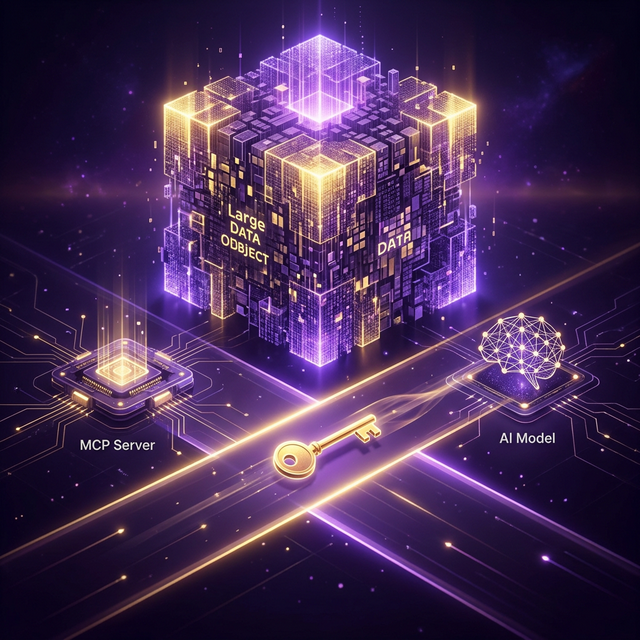
The Solution: Reference Instead of Content
Instead of injecting the entire file into the conversation, the server uses an artifact store (such as the mlcartifact server). The flow changes fundamentally:
- Action: The LLM calls a tool (e.g.
generate_report). - Storage: The MCP server generates the PDF and stores it as an artifact.
- Response: The server returns only a short text note to the LLM:
"Report generated and available as artifact with ID
REPORT-2026-01." - Information: The LLM informs the user: "I have created the report. It is ready for you as artifact REPORT-2026-01."
The Role of the Intelligent Client
The real magic happens on the client side (the UI). A modern chat client sees the ID in the model's response and can:
- Load the artifact from the artifact server in the background.
- Render the image or document inline in the chat (without the LLM ever having seen it).
- Offer a download button for formats like Word or PDF.
Why This Pattern is the Future
This principle (mlcartifact) offers decisive advantages:
- Format independence: You can support ANY format (CAD models, videos, complex datasets), because the LLM only manages the metadata.
- Context preservation: The model's "working memory" stays clean and focused on the logic, not the raw data.
- Security & longevity: Artifacts can be stored separately, versioned, and given permissions.
- Cost control: You do not pay token fees for transferring binary noise to a model that would not understand it anyway.
Reference Implementation
The mlcartifact server is an exemplary implementation of this pattern. It serves as specialised storage for MCP artifacts and enables the decoupling of data content and model context.
Conclusion
The Artifact Pattern transforms the MCP stack from a pure chat extension into a professional production environment. Projects like mlcartifact show how to marry the cognitive abilities of AI with the performance of classical file systems and document management systems.
← Chapter 12: Limits & Boundaries | Table of Contents | Next Chapter: Quality Assurance →
Copyright Michael Lechner - 2026-02-28